
NYC 2022 Code: Chapter 33 Revisions-3301
NYC 2022 Code: Chapter 33 Code Revisions – 3310 Requirements for the Construction or Demolition of Major Buildings
NYC 2022 Code: Chapter 33 Code Revisions – 3308 Unenclosed Perimeter Protection
3308 – Unenclosed Perimeter Protection
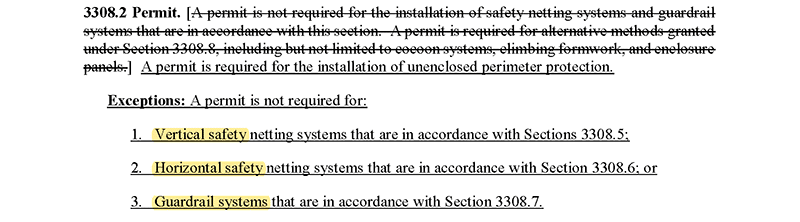
The revised code makes clearer that typical vertical and horizontal netting, as well as guardrails, do not require an application submission and permit from DOB. Vertical and horizontal netting, however, require design (no change here). Typical guardrails that meet the specifications in 3308.7 do not require design. These specifications are similar to OSHA’s requirements. Deviations from these guardrail specifications will require design meeting loading criteria established in the code (no change here)
You can see the revision here:
One of the exceptions to the need for vertical netting at window openings has been modified. The exception now requires that the sill height be 42 inches, not 2 feet. Otherwise, 60” vertical netting must be maintained.

The zero cable is now required to be secured to the deck and remain in contact with the deck to prevent small debris from getting under the netting.

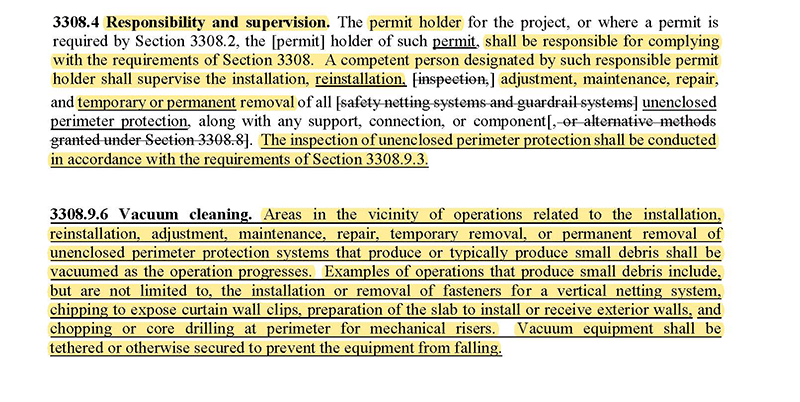
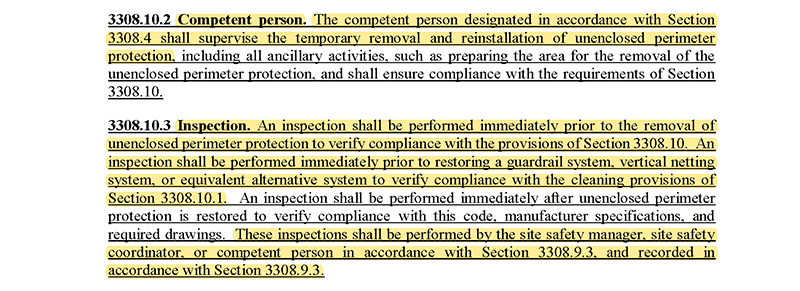
The revised code makes clear that the installation, maintenance, and removal of the unenclosed perimeter protection systems must be supervised by the project permit holder and his designated competent person. Also, a new section was added for inspection requirements and for vacuum cleaning of areas at the perimeter when work is performed that typically produces dust and small debris. Vacuuming is also necessary prior to temporary removal of unenclosed perimeter protection. The object here is to mitigate material/debris/equipment fall hazards at the perimeter, especially when the protection is temporarily removed. It is quite common for debris to be outside the vertical netting and resting on the concrete slab eyebrows. These inspections should be recorded in the SSM, SSC, CS, logbook or otherwise documented by the competent person.
NYC 2022 Code: Chapter 33 Code Revisions – BC 3301.13.7 Duties of Construction Superintendents
BC 3301.13.7– Duties of Construction Superintendents
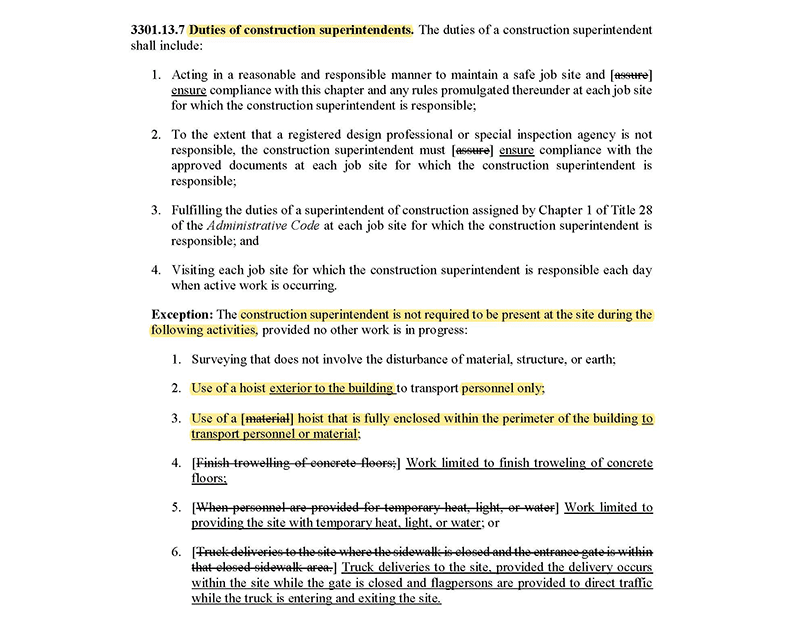
The existing code provided for exceptions to the construction superintendent’s presence on site. Previously, the construction superintendent did not have to be on site to use the exterior hoist to transport personnel only. The interior hoist in a fully enclosed building could be used to transport material. The revision allows the interior hoist to be used to transport both material and personnel. This was just a cleanup. The previous code probably intended this anyway.
You can see the revision here:
NYC 2022 Chapter 33 Construction Code Revisions – BC 3306 – Demolition
Introducing BC 3306 – Demolition
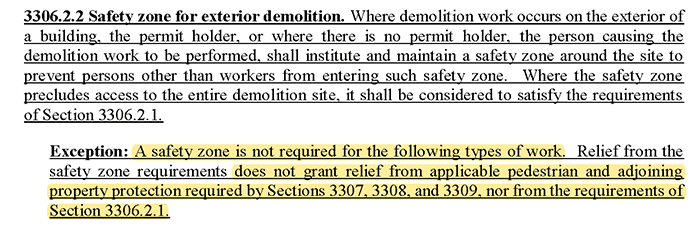
The existing code sections pertaining to exterior demolition safety zones, required to mitigate material/debris fall hazards to the public, have been revised and include several exceptions. The changes are relatively minor.
The safety zone prevents unauthorized persons from entering the demolition area. The safety zone does not pertain to authorized demolition workers, though such workers would still be covered under OSHA’s broad material fall hazard mandate.
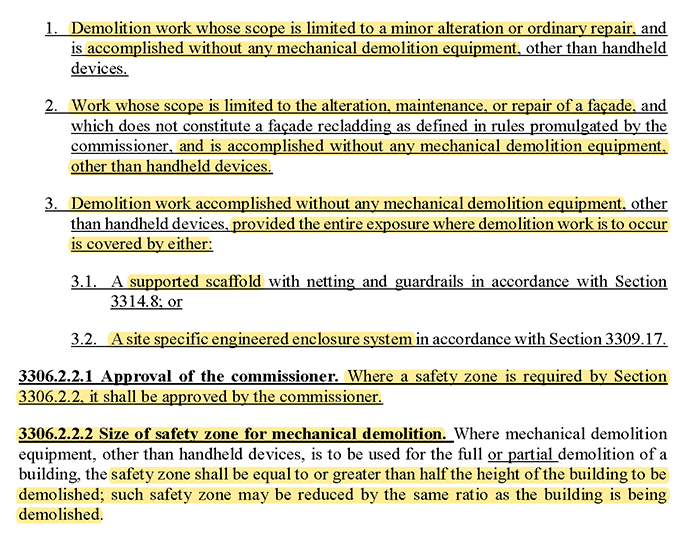
The exceptions to the requirement for a safety zone apply only to minor alterations/ordinary repairs (including façade repair and maintenance) performed without the use of mechanical demolition equipment, except handheld devices. For demolition beyond this scope of work, a safety zone exception is allowed if the exterior is enclosed with a supported scaffold and vertical netting or a “site-specific engineered enclosure”, provided no mechanical equipment is used, except hand-held equipment. This latter exception is new.
When a safety zone is required, it must be approved by the commissioner (illustrated on the site safety plans and, on the demolition, means/methods plans). Except for mechanical demolition, the size of the safety zone is not stipulated. For mechanical exterior demolition (using other than handheld devices), the safety zone is ½ the height of the building at any given stage of demolition. The safety zone can be contracted as demolition progresses toward grade, provided the zone remains equal to or greater than ½ the height of the building. This requirement for mechanical demolitions can prove difficult or impossible to comply with for high-rise demolition of buildings with street walls and perimeter walls on the lot line because there is no supported scaffold or site-specific engineered enclosure exemption for mechanical demolition, only for non-mechanical. Nothing has really changed in this regard, but DOB historically has waived the safety zone requirement when the site was cocooned with a supported scaffold and debris netting, even for mechanical demolitions staged within the building. But this policy was not codified this round. However, the contractor always has the option of filing a CCD-1 and requesting a variance.
It should be noted that an open pedestrian walkway protected by a sidewalk shed cannot be located within the safety zone, as the safety zone is required to prevent unauthorized persons from entering the zone.
NYC 2022 Code: Chapter 33 Code Revisions – BC 3307 – Protection of Pedestrians
BC 3307 – Protection of Pedestrians
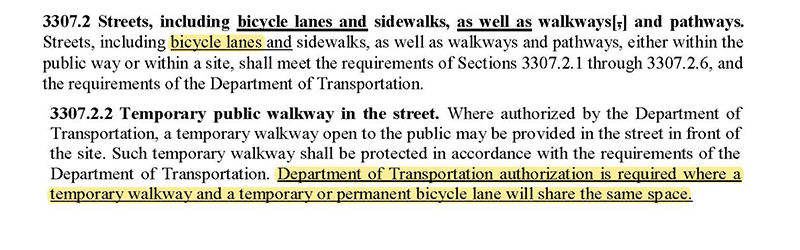
The existing code required the protection of sidewalks and pedestrian walkways when overhead work was planned. The revised code added bicycle lanes as well. Protection shall be in accordance with DOT regulation. When a temporary walkway will occupy a bicycle lane and share that bike lane, DOT authorization is required.
You can see the revision here:
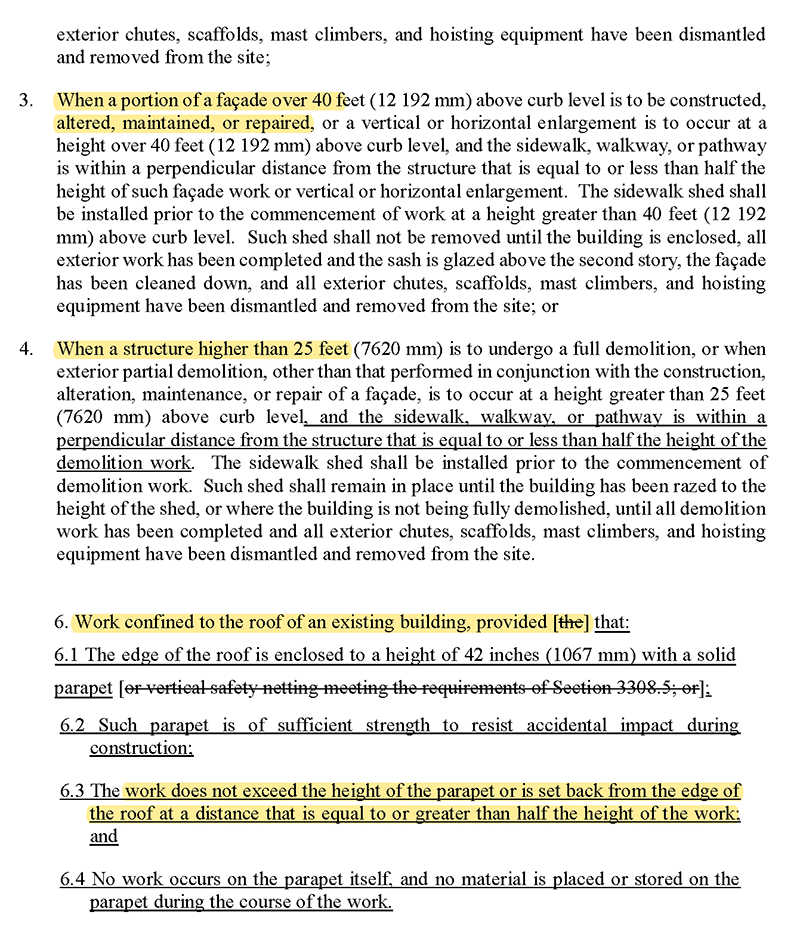
The revised code modified and added to some of the sidewalk shed exceptions, some as-of right and some requiring specific approval by DOB (i.e., variance/CCD-1).
Exemptions:
- Work confined to the existing roof of a building with a solid parapet of 42 inches (vertical netting no longer permitted) is exempt from sidewalk shed requirements, provided the work does not take place above the level of the parapet or if above, the work is set back from edge at least ½ the height or more of the highest work. (No CCD-1)
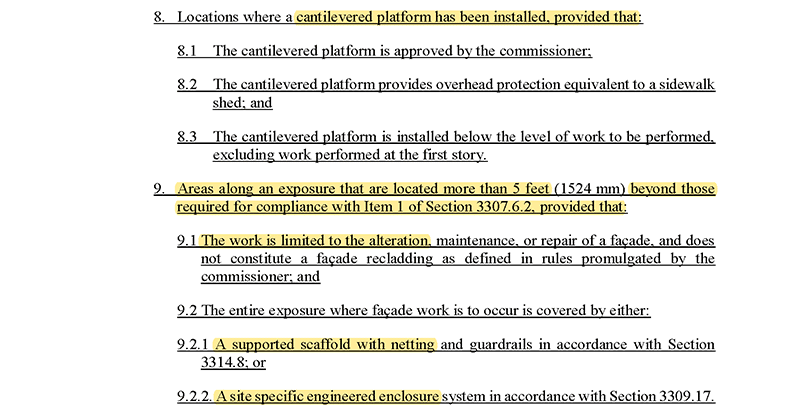
- Cantilever OHP of sidewalks is now allowed in lieu of a post-supported sidewalk shed (SWS), provided the loading requirements of a sidewalk shed are met (150/300 PSF, depending on height of building above sidewalk requiring the protection).
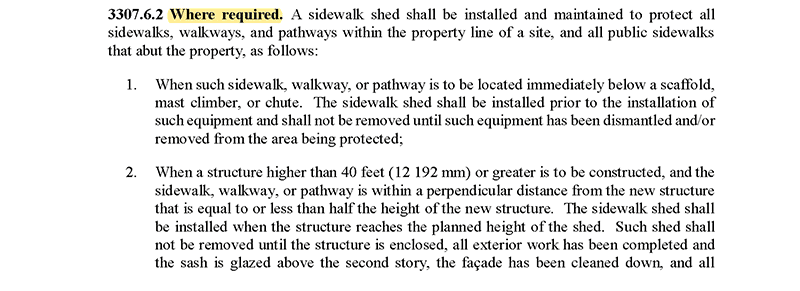
- For existing bldgs. 40 feet or less in height undergoing typical façade repair and enclosed by a supported scaffold [or site-specific engineered enclosure (3309.17)], the area of sidewalk/walkway beyond 5 feet from the supported scaffold face does not require a sidewalk shed. (CCD-1 Required). Remember, if the scaffold or equipment installation is in association with work that is covered by 3307.6.2, Paragraph 2, 3, or 4, it is those section that determine the coverage of the sidewalk shed deck. Basically, if you fall under those sections (NB or façade alteration greater than 40 feet or DM greater tan 25 feet), the sidewalk shed must cover the full width of the sidewalk, minus 18 inches at the curb to clear street furniture, trees, hydrants, DOT signs, etc.
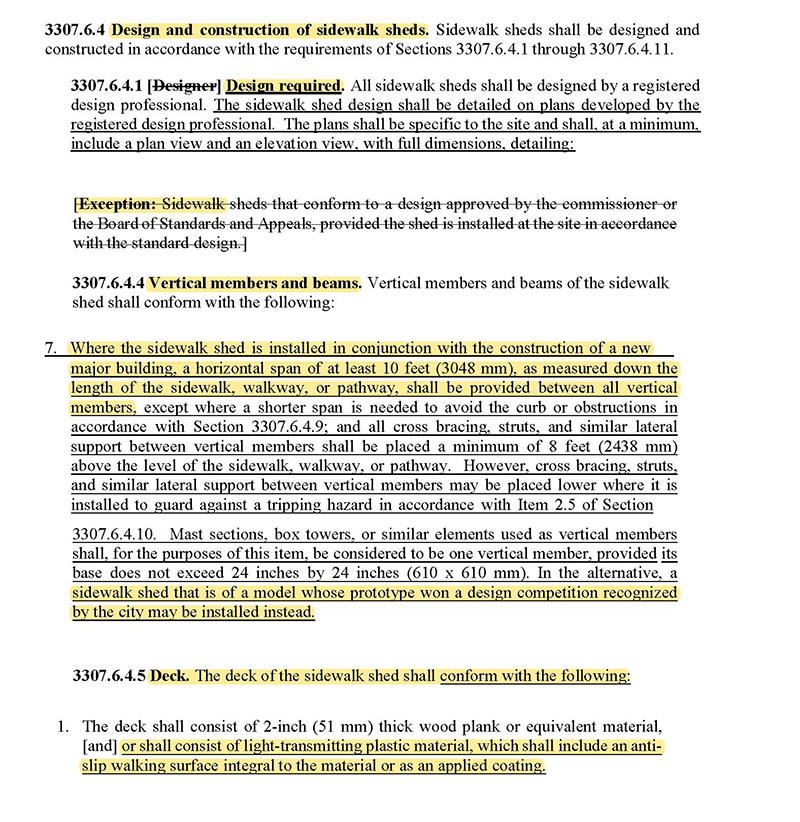
The existing code provided an exception to the requirement for professional design of sidewalk sheds, provided the sidewalk shed conforms to an approved BSA standard. This exception has been removed from the revised code. Now all sidewalk sheds require professional design.
The revised code added a requirement for a 10-foot minimum spacing between vertical posts on sidewalk sheds (in the long direction) installed pursuant to major new building work. This will adversely impact sidewalk shed suppliers, as the current typical spacing is 8 feet. In addition, the horizontal bracing elements must be a minimum of 8 feet above the ground. The “Urban Umbrella” (the prototype design that won a city design competition) is exempt from this requirement.
The revised code now allows the sidewalk shed deck to be a translucent material. When translucent material is used, no storage is permitted.
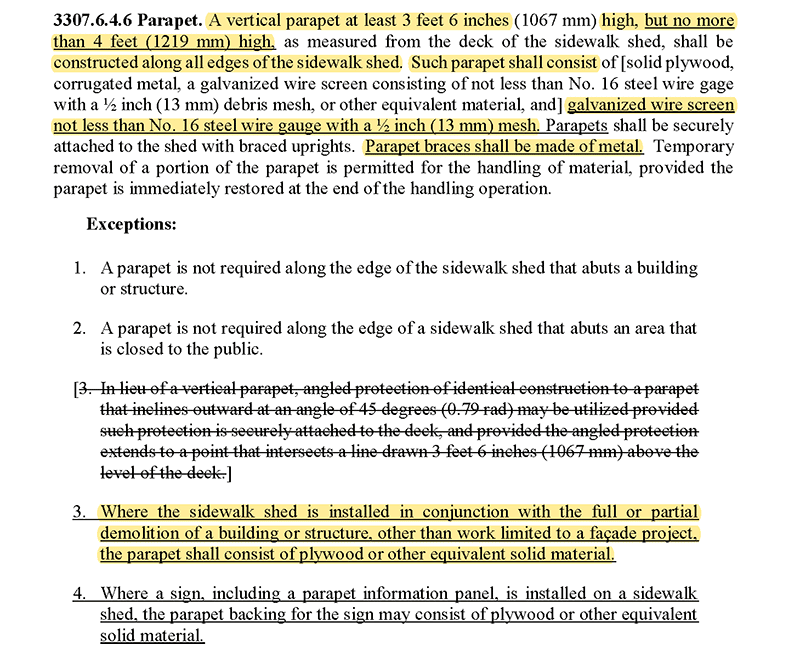
Sidewalk shed parapets are now required to be galvanized wire screen, instead of solid wood. This will cut down on failures due to wind loading. The inclined braces for parapets must now be metal (which is common now). Parapets of sidewalk sheds used in conjunction with full or partial exterior demolition (except for façade repair/maintenance) must still be made of solid material.
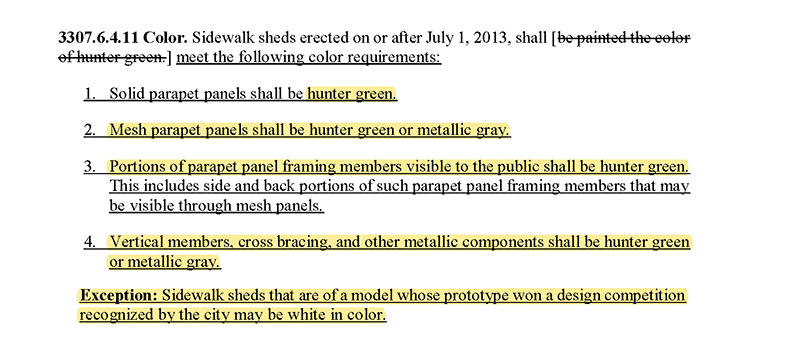
Revisions have been made to the color requirements for sidewalk sheds. Solid parapets still need to be hunter green. Mesh parapets can be hunter green or metallic grey. Structural supports can be hunter green or metallic grey. One curious exception is that a sidewalk shed prototype that won a design competition recognized by the city can be white. There is only one such sidewalk shed: the so-called Urban Umbrella.
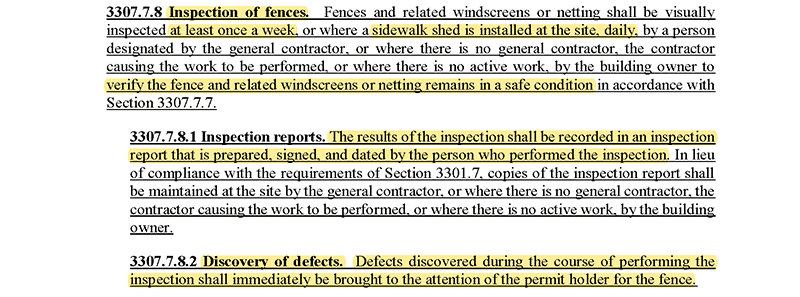
A new weekly inspection requirement was added to the new code for fences. Where a sidewalk shed is also installed at the site, both the sidewalk shed and fence need to be inspected daily. Documentation of all inspections must be kept on site. The color of the fence remains the same—hunter green, exception fences installed on sites with “Urban Umbrella” sidewalk sheds can be the same color as the SWS (white).

NYC 2022 Code: Chapter 33 Code Revisions – BC 3303.16 Worker Sheds, Contractor Sheds and Similar Structures
BC 3303.16 – Worker Sheds, Contractor Sheds and Similar Structures
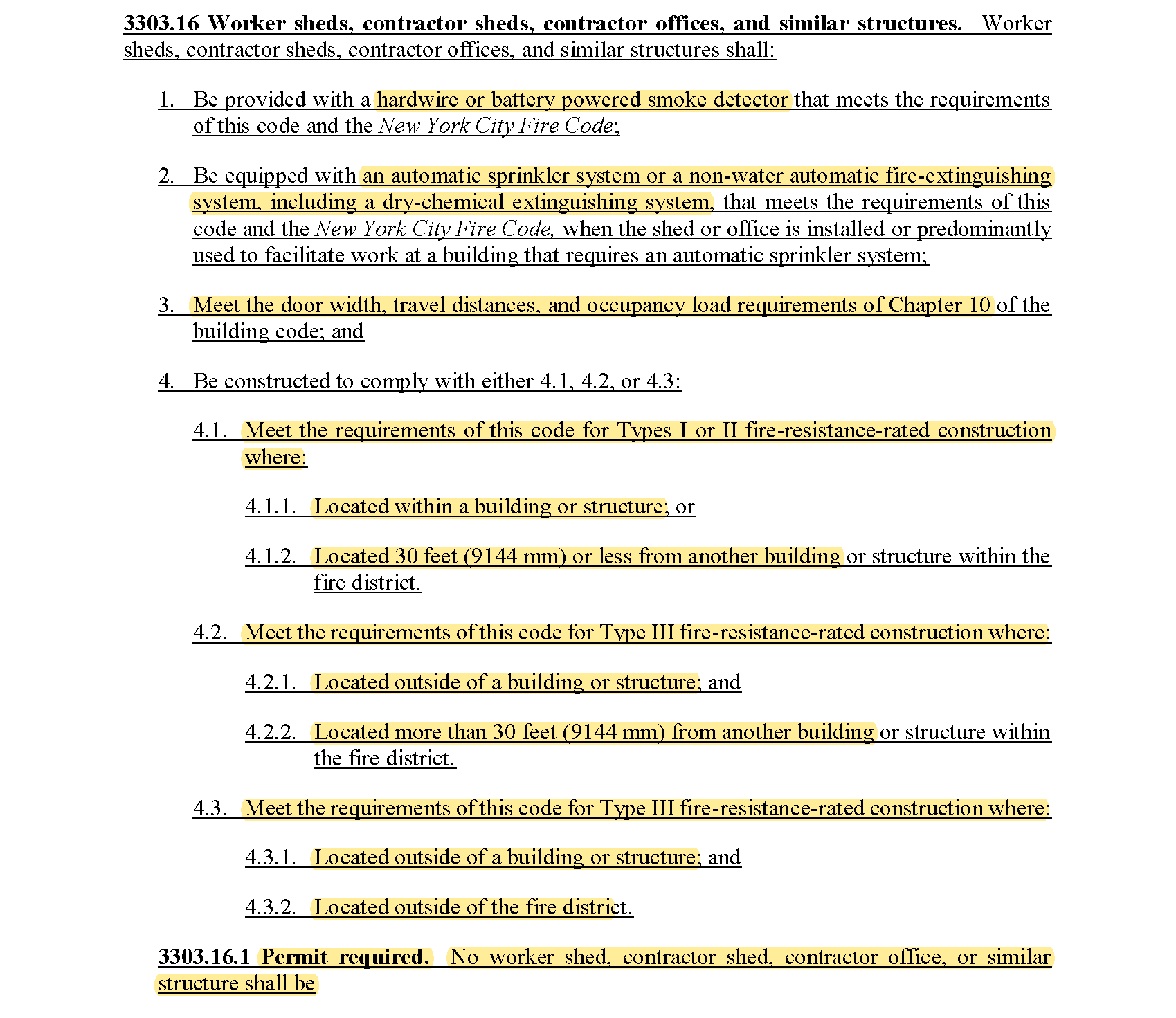
The existing code did not require a permit for contractor shanties/offices, even though DOB inspectors often asked for permits for large contractor offices. The shanties/offices within 30 feet of an existing bldg., a new bldg., or another shanty/office had to be non-combustible construction with few exceptions (exceptions limited to 1 story and 120 square feet in area, more than 30 feet from another shanty/office, and constructed of fire-retardant wood protected from elements by sheet metal).
The revised code now requires the installation of smoke detectors and wet sprinklers or dry chemical extinguishers (commonly used today) and compliance with egress requirements of Chapter 10, as they relate to door width and travel distance. The construction of the shanty/office must meet the requirements of Class I, II (non-combustible) or III fire-resistant construction (protected combustible), depending on the location of the shanty/office (inside structure, inside fire district, within 30 feet of another shanty/office).
A permit is needed for the construction of the shanty/office, except if the shanty/office does not exceed 1 story and 120 square feet and is located more than 30 feet from another shanty/office. However, permits are needed for all utility hookups (electric, plumbing, etc.) without exception
You can see the revision here:
NYC 2022 Code: Chapter 33 Code Revisions – BC 3303.4.11 Daily Inspection of Housekeeping
3303.4.11 Daily Inspection of Housekeeping
The revised code has added a daily inspection requirement for general housekeeping to ensure compliance with 3303.4.1 through 3303.4.10. The inspection and results are required to be noted in the SSM/SSC or CS logbooks.
You can see the revision here:

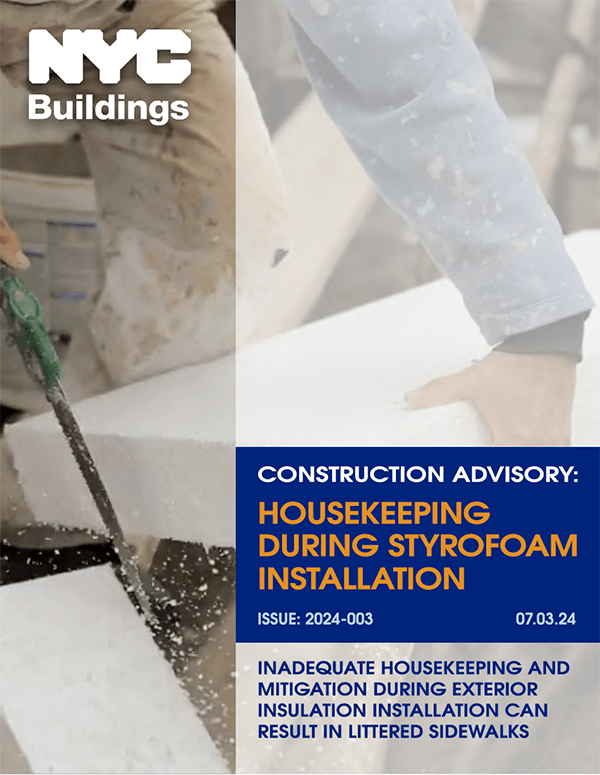
Update: July 3, 2024:
NYC DOB releases remimnder Construction Advisory: (click to download)
NYC 2022 Code: Chapter 33 Code Revisions – BC 3303.11.2 Stairs During Building Construction or Enlargements
BC 3303.11.2 – Stairs During Building Construction or Enlargements
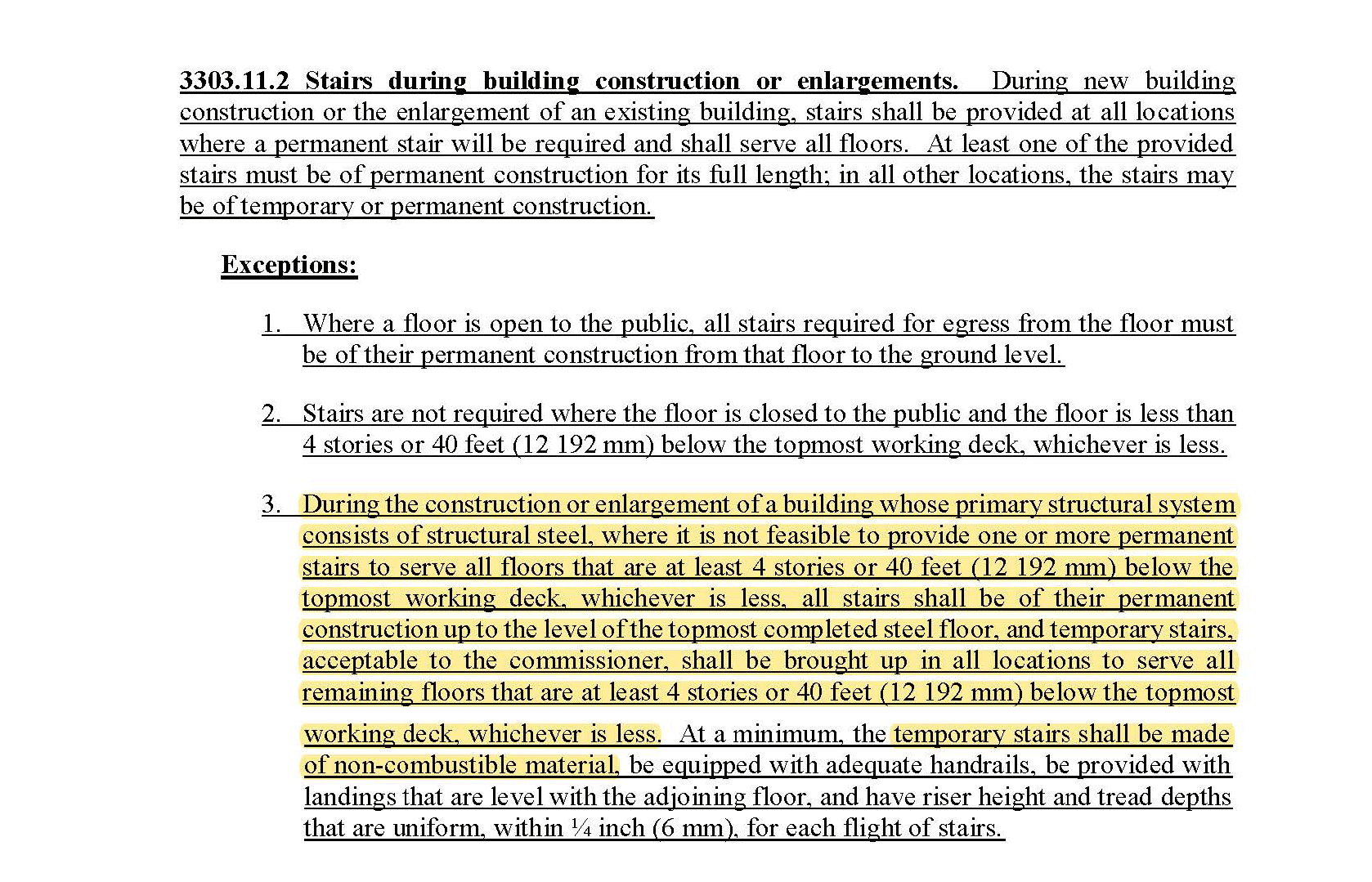
The existing code requires the maintenance of temporary and permanent stairs during new building construction and vertical enlargements to within 4 stories or 40 feet of the topmost working deck. At least one permanent stair had to be brought up, and in all other locations where permanent stairs would be located in the completed building, temporary stairs were permitted. The revised code provides an exemption to this requirement for structural steel buildings. Recognizing that the structural framing may not be completed to a degree that would allow the permanent stairs to be installed within 40 feet or four stories of the working deck, the revised code requires the permanent stairs to be completed to the topmost completed steel floor. From that completed steel floor upward, the contractor is to provide non-combustible temporary stairs (scaffold stairs) to within 40 feet/4 stories of the top working deck. The revised code also provides basic specifications for those temporary stairs. Though not explicit in the code, it is assumed these same specifications would apply to any temporary construction stair installed in lieu of a permanent stair.
You can see the revision here:
NYC 2022 Code: Chapter 33 Code Revisions – BC 3303 – Safeguards and Maintenance of Site
BC 3303 – Safeguards and Maintenance of Site
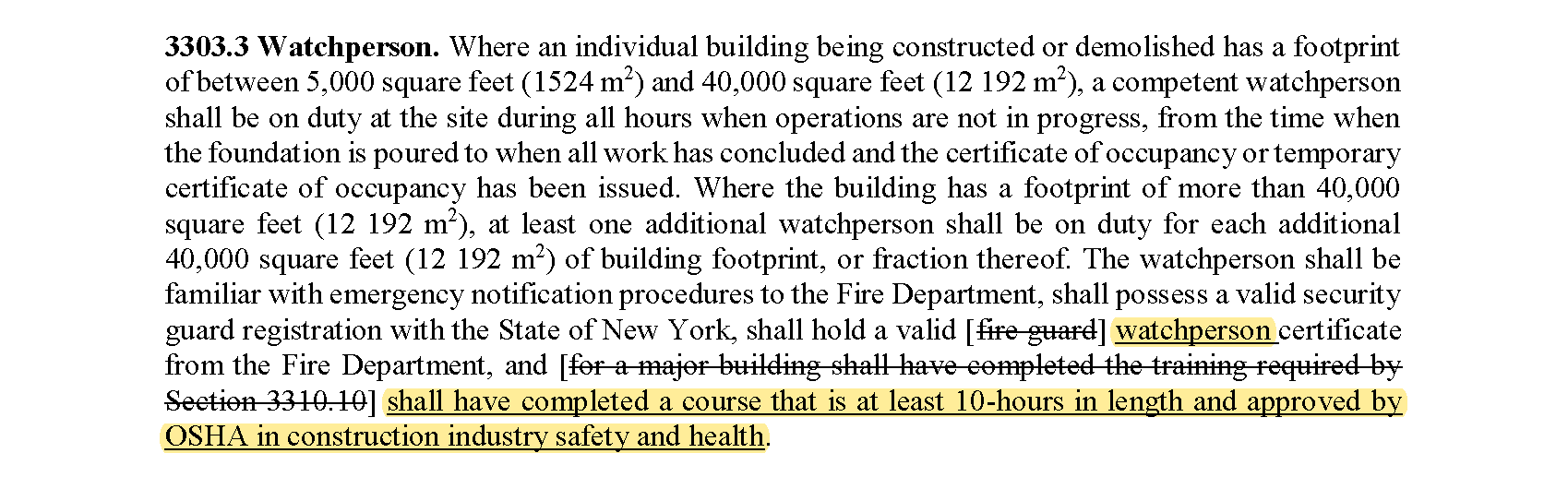
You may already know that existing code required that a watchperson on major buildings have OSHA 10 training. But starting November 7, 2022, the revised code requires that training on both major and non-major buildings. In addition, the former code required that the watchperson have FDNY fireguard certification. THE REVISED CODE requires an FDNY watchperson certification.
This revised code went into effect November 7th, 2022 and there is lots more to BC 3303, including container material specifications, unenclosed perimeters, daily inspection of housekeeping, chute construction, floor numbering and much more!
See the full Chapter 33 revisions in full at the NYC DOB website. See section 3303.3 on page 20 for the complete code.
*Note: These are not retroactive requirements, unless specifically stated.
You can find the Chapter 33 Safeguards During Construction OR Demolition General Section here…
You can find Local Law 126, authorizing the revisions of these building codes here
NYC 2022 Code: Chapter 33 Code Revisions – BC 3304.4 – Guardrail System
In our SAFETY Updates series we’ll be sharing important revisions to NYCDOB’s Chapter 33 Construction Code – Safeguards During Construction or Demolition
BC 3304.4.4 – Guardrail System
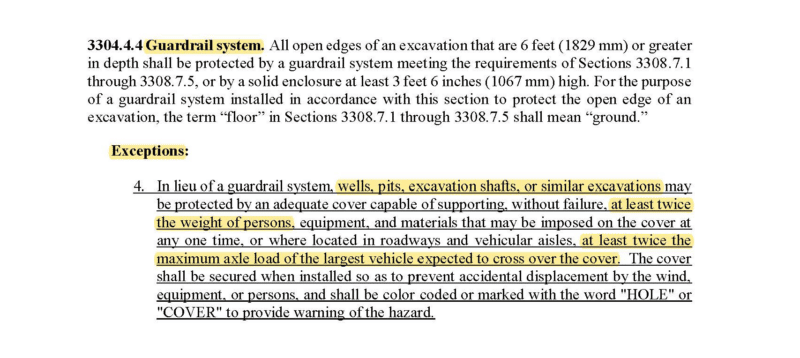
A common-sense guardrail exemption has been added to the revised code, allowing an adequate cover to be used in lieu of guardrails for wells, pits, shafts, or similar excavation. The design specifications for the cover found in OSHA regulations have been incorporated into the code. Basically, the cover must support all intended load (person or vehicle/equipment) with a 2X factor of safety and be fastened and labeled.
You can see the revision here:
NYC 2022 Code: Chapter 33 Code Revisions – BC 3304.7 – Access to Excavations
BC 3304.7 – Access to Excavations
Existing code required at least one means of egress from general open-cut excavations. The revision incorporates the OSHA requirement for multiple means of ingress/egress for trenches (trench definition: 4 feet or greater in depth and 15 feet or less in width) greater than 25 feet in length. This revision makes clear that multiple means of ingress/egress only apply to trenches and not open excavations.
You can see the revision here:

NYC 2022 Code: Chapter 33 Code Revisions – BC 3303.4.11 Daily Inspection of Housekeeping
3303.4.11 Daily Inspection of Housekeeping
The revised code has added a daily inspection requirement for general housekeeping to ensure compliance with 3303.4.1 through 3303.4.10. The inspection and results are required to be noted in the SSM/SSC or CS logbooks.
You can see the revision here:
Update: July 3, 2024:
NYC DOB releases remimnder Construction Advisory: (click to download)
NYC 2022 Code: Chapter 33 Code Revisions – BC 3303.11.2 Stairs During Building Construction or Enlargements
BC 3303.11.2 – Stairs During Building Construction or Enlargements
The existing code requires the maintenance of temporary and permanent stairs during new building construction and vertical enlargements to within 4 stories or 40 feet of the topmost working deck. At least one permanent stair had to be brought up, and in all other locations where permanent stairs would be located in the completed building, temporary stairs were permitted. The revised code provides an exemption to this requirement for structural steel buildings. Recognizing that the structural framing may not be completed to a degree that would allow the permanent stairs to be installed within 40 feet or four stories of the working deck, the revised code requires the permanent stairs to be completed to the topmost completed steel floor. From that completed steel floor upward, the contractor is to provide non-combustible temporary stairs (scaffold stairs) to within 40 feet/4 stories of the top working deck. The revised code also provides basic specifications for those temporary stairs. Though not explicit in the code, it is assumed these same specifications would apply to any temporary construction stair installed in lieu of a permanent stair.
You can see the revision here:
NYC 2022 Code: Chapter 33 Code Revisions – BC 3303 – Safeguards and Maintenance of Site
BC 3303 – Safeguards and Maintenance of Site
You may already know that existing code required that a watchperson on major buildings have OSHA 10 training. But starting November 7, 2022, the revised code requires that training on both major and non-major buildings. In addition, the former code required that the watchperson have FDNY fireguard certification. THE REVISED CODE requires an FDNY watchperson certification.
This revised code went into effect November 7th, 2022 and there is lots more to BC 3303, including container material specifications, unenclosed perimeters, daily inspection of housekeeping, chute construction, floor numbering and much more!
NYC 2022 Code: Chapter 33 Code Revisions – BC 3304.4 – Guardrail System
BC 3304.4.4 – Guardrail System
A common-sense guardrail exemption has been added to the revised code, allowing an adequate cover to be used in lieu of guardrails for wells, pits, shafts, or similar excavation. The design specifications for the cover found in OSHA regulations have been incorporated into the code. Basically, the cover must support all intended load (person or vehicle/equipment) with a 2X factor of safety and be fastened and labeled.
You can see the revision here:
NYC 2022 Code: Chapter 33 Code Revisions – BC 3304.7 – Access to Excavations
BC 3304.7 – Access to Excavations
Existing code required at least one means of egress from general open-cut excavations. The revision incorporates the OSHA requirement for multiple means of ingress/egress for trenches (trench definition: 4 feet or greater in depth and 15 feet or less in width) greater than 25 feet in length. This revision makes clear that multiple means of ingress/egress only apply to trenches and not open excavations.
You can see the revision here: